

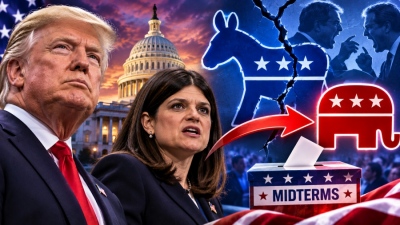
The US midterm elections are evolving into an exceptionally complex political contest, with Democrats appearing strengthened in critical Senate polls, yet simultaneously confronting severe internal conflicts. The emerging picture proves contradictory: on one side, polling records a Democratic lead in seven states likely to determine Senate control. On the other hand, intra-party conflict in Michigan, starring Representative Haley Stevens, reveals deep political and ideological cracks. Stevens, who lost the Democratic primary to Abdul El-Sayed, executed a move triggering a political earthquake: announcing her endorsement of Republican Mike Rogers, backed by Donald Trump. Her decision caused staff resignations, angry reactions from Democratic leadership, and fresh tension in a state where the battle for the Senate is deemed decisive, impacting Democratic party unity.
Democrats lead in 7 states, but polling credibility is questioned
According to the latest polls presented in the relevant New York Times coverage, Democrats appear ahead in seven states likely to determine Senate control: Michigan, Kansas, Texas, Maine, Ohio, Alaska, and Iowa. The polling picture displays significant Democratic reinforcement at a time when Donald Trump's popularity has receded into the mid-30s, according to cited figures. However, this picture is not necessarily as clear as it appears. The New York Times poses serious questions regarding polling methodology, as Democrats seem to participate in surveys at a higher rate than Republicans. Specifically, registered white Democrats appear 30% more likely to participate in polls compared to registered white Republicans. This metric creates concern over whether surveys underestimate Republican strength. Comparisons with older weighting methodologies show Democratic leads would be even larger across several states. This reinforces the question of whether new methods capture the electorate better or if non-response bias affects specific voter groups, altering electoral survey accuracy.
Michigan: Haley Stevens abandons Democrats and endorses Mike Rogers
Amidst this political environment, developments in Michigan generate particular sensation. Representative Haley Stevens, who lost the August Democratic primary for the Senate to Abdul El-Sayed, announced her endorsement of Republican Mike Rogers. Stevens appeared Sunday, November 1, alongside Rogers at the Perfecting Church in Detroit, an exceptionally unusual move for an incumbent Democratic representative just two days before elections. Her decision caused immediate upheavals in her political office. According to reports, staff members—including her long-time chief of staff—submitted their resignations. Senate Minority Leader Chuck Schumer characterized the move as a "vile betrayal." On social media, critics argued she "sold her soul" for power, reshaping Michigan Senate race dynamics.
On the eve of the eve of the eve of our BIG and important election, a unifying moment has arrived, our democratic nominee for U.S Senate disavows the Rebellion PAC ad made by Hasan Piker’s uncle that claims Jews are responsible for America’s economic woes. We have learned from party leaders and emissaries, as reported in the news media that he has. On Sunday I will join with the Great Democratic leader, Jim Clyburn and Dr El Sayed for a church service in the beautiful city of Detroit. The political coalition of Black and Jewish voices that have carried Michigan and this country through so many storms to the righteous path of liberal democracy and equal opportunity for all will ring out. Full statement here:
— Haley Stevens (@HaleyforMI) October 30, 2026
Conflict over Israel dissolved Democratic unity
The rift between Stevens and El-Sayed links to controversy surrounding an ad by Rebellion PAC, an external political group not officially connected to the Democratic candidate's campaign. The ad, posted by Cenk Uygur, connected high food prices in the US with US foreign assistance to Israel. Stevens demanded El-Sayed condemn the ad, arguing it reflected his own political rhetoric. El-Sayed responded that Stevens was attempting to stir up an intra-party contest settled three months ago. His campaign team even requested she no longer appear at campaign events. He clarified he did not create the ad and disagreed with its content. Despite clarifications, the dispute evolved into a major problem for Democrats, exposing difficulties in managing internal differences over Israel, influencing US-Israel policy debates.
Polling picture in Michigan and the critical battle for the Senate
The contest in Michigan carries special significance for Senate control. According to a WDIV and Detroit News poll conducted by Glengariff Group between October 19 and 22 among 600 likely voters, Abdul El-Sayed gathered 51.4%, with a margin of error of 4 percentage points. Developments involving Haley Stevens add another layer of uncertainty to this electoral contest. The political problem for Democrats is that while polls show the party leading in key states, internal confrontation in Michigan demonstrates that party unity cannot be taken for granted, defining Michigan voter sentiment.
The big question: Democratic wave or fresh polling failures?
The picture across the seven key states remains the core element of the electoral contest.
-
In Michigan, Abdul El-Sayed appears to lead, but intra-party confrontation with Haley Stevens causes upheavals.
-
In Texas, James Talarico appears to lead Ken Paxton by seven points.
-
In Kansas, Adam Hamilton holds a lead over Roger Marshall.
-
In Maine, Troy Jackson leads Susan Collins by six points.
-
In Ohio, Sherrod Brown appears ahead by five points.
-
In Iowa, the contest between candidates remains exceptionally competitive.
-
In Alaska, Mary Peltola lost ground compared to previous measurements. The critical issue is whether polling findings capture genuine shifts in the electorate or whether methodological weaknesses and unequal survey participation create a misleading picture. Democrats appear to possess significant momentum, yet internal conflicts and polling credibility questions create a far more complex backdrop. The Haley Stevens case shows that the Democrats' battle is not fought solely against Republicans. It is fought inside the party itself as the ballot box approaches, impacting battleground state forecasts.
Scandal with polls
The latest New York Times/Siena polls place Democrats ahead across all states likely to determine Senate control following the US midterm elections on November 3. Nevertheless, lower Republican participation in surveys and errors from previous election cycles raise questions regarding result reliability. Democrats reinforce their momentum right up until the final moment, according to final New York Times/Siena University polls for the 2026 midterm elections. The Democratic Party leads in all seven states considered most likely to determine Senate control: Michigan, Kansas, Texas, Maine, Ohio, and, by narrower margins, Alaska and Iowa. The picture strikes observers as remarkable, since months ago such a strong Democratic presence in states traditionally considered safe for Republicans would have appeared exceptionally difficult. In today's era of intense political polarization, no easily comparable precedent exists for a party recording such positive performances across so many opposing party states. The closest comparisons are Democratic victories in 2006 and 2008, yet current polls display even greater momentum. Polling averages also show Democrats leading in the same states, giving them an advantage in more Republican-controlled seats than they managed to win overall during the 2006 and 2008 elections. However, the other side exists as well: in the era of Donald Trump, polls have repeatedly overestimated Democratic electoral strength. Therefore, the possibility remains open that measurements once again present an overly favorable picture for the Democratic Party, shaping US Senate race outlooks.
Trump's falling popularity changes the landscape
Donald Trump supporters appear relatively reluctant to participate in polls, creating the risk of systematic polling error. Despite these problems, the Democratic lead remains large enough for them to win Senate control even if polls underestimate Republicans to the degree seen in 2016 or 2020. The political juncture proves particularly difficult for the US president. Historically, prolonged foreign military engagements and high domestic prices constitute a combination impairing presidential performance. Following the American strike on Iran, Donald Trump’s approval ratings receded into the mid-30s, falling even below the level previously considered the floor of his political support. Trump emerges as the least popular president heading into midterm elections since Harry Truman in 1946. For the first time, a significant proportion of voters with traditional Republican leanings declare disapproval of the president's performance. His popularity sits noticeably lower compared to previous electoral contests of the Trump era, even those where Republicans suffered heavy losses. His approval ratings stand at least 10 percentage points lower than in 2025, prior to decisive Democratic victories in New Jersey and Virginia. They also stand 12 points lower than the period prior to the 2018 elections, when Democrats won the national vote by nearly nine points in an electoral contest characterized as a blue wave.
Texas and Kansas: Democrats see opportunity in traditional Republican states
At the start of 2026, Texas and Kansas were not considered core opportunities for Democrats in their effort to capture Senate control. The party has not won a Senate seat in these states across many electoral cycles. Today, however, they emerge as two of Democrats' greatest opportunities in states that traditionally vote Republican. This picture emerges not only from New York Times/Siena polls but also from the average of other recent measurements. A core problem for Republicans involves candidate quality. Ken Paxton in Texas and Senator Roger Marshall in Kansas rank among the party's least popular candidates this electoral cycle. Their negative ratings worsened since September polls despite advertising expenditures totaling tens or hundreds of millions of dollars on their behalf. A mere 33% of voters in Texas hold a favorable view of Ken Paxton, who faced investigations, criminal charges, and impeachment proceedings. Conversely, 54% hold an unfavorable view. Similarly, Roger Marshall, a former physician, garners positive ratings from 39% and negative ratings from 50% of voters. His popularity suffered following a New York Times report stating he took legal action against hundreds of patients for small medical service debts. Concurrently, he sparked reactions with a series of campaign statements, including his reference that "this is one of the best economies I have seen in my life." These performances prove particularly problematic for Republican candidates in states traditionally backing the party. In 2018, Senator Ted Cruz came close to defeat against Beto O’Rourke, yet back then Texas voters held favorable views of Cruz and approved Donald Trump's presidential performance, altering Republican candidate vulnerabilities.
James Talarico and Adam Hamilton strengthen the Democratic front
Unlike Republicans, Democrats selected two candidates with strong appeal. In Texas, James Talarico and in Kansas, Adam Hamilton display high popularity ratings and can attract voters beyond their narrow partisan base. Both utilize their theological training on the campaign trail. Adam Hamilton serves as senior pastor of the largest United Methodists church in the US, while James Talarico studied at a theological seminary. Among examined states, Kansas experienced the largest shift toward Democrats during the past month. Adam Hamilton became far better known to voters, with the percentage of those lacking formed opinions on him dropping from 36% to a mere 6%. As voters grew better acquainted with both him and Roger Marshall, Hamilton secured a clear lead. In Texas, Republicans face an additional problem: a significant drop in support from Hispanic voters. The poll grants James Talarico a 38-point lead among this demographic group, registering 65% against 27%. This represents a major shift compared to 2024, when Hispanic voters split almost evenly between the two candidates in the presidential election, per Times Voter Trends data. Such a shift could transform Texas into a battleground state even if Ken Paxton lacked such severe popularity problems. Indicatively, Republican candidates lead by less than one percentage point overall across House districts in Texas, while Democrat Gina Hinojosa leads by one point in the gubernatorial race, shaping Sun Belt voting trends.
Maine and Michigan: The largest Democratic surges
The largest Democratic gains since September register in Maine and Michigan, the two states with the most favorable electoral environment for Democrats among key Senate battlegrounds. Together with results from the latest Minnesota poll, this picture indicates the overall political environment makes it difficult for Republicans to attract voters traditionally leaning toward Democrats. In Maine, Troy Jackson now leads by six points, whereas in September he trailed by three. Despite his lead, Jackson retains relatively low popularity among state voters and remains less popular than Republican incumbent Senator Susan Collins.
Nevertheless, the gap between the two narrowed as the share of voters holding favorable views of Collins dropped from 51% to 48%. In Michigan, the picture differs. Dr. Abdul El-Sayed now leads by a double-digit margin. Unlike Maine and Minnesota, Republicans here lack a clear advantage regarding candidate quality. Republican Mike Rogers holds an unfavorable rating, while El-Sayed garners favorable opinions. Latest polls show El-Sayed consolidating steady gains over the past month by rallying voters leaning toward Democrats who initially approached his candidacy with reservation. His lead now matches his party's performance in House district elections statewide. In September, conversely, he trailed the general Democratic vote intention by six points. The poll took place almost entirely prior to Haley Stevens's striking, last-minute endorsement of Mike Rogers—Stevens being El-Sayed's primary rival in the Democratic primaries.
Nevertheless, the measurement revealed no substantive signs of internal discord within the Democratic camp. El-Sayed leads 96% to 2% among voters stating they voted for Kamala Harris, up from 91% to 5% in September. His support from Black voters, who appeared more hesitant in September, also runs strong today, backing him 93% to 4%. Mike Rogers failed to secure support from a single respondent in the city of Detroit. Concurrently, voters over 65 shifted toward El-Sayed, though he still trails Democratic gubernatorial nominee Jocelyn Benson significantly within this specific age group, influencing Rust Belt electoral dynamics.
Ohio, Iowa, and Alaska: Narrower margins for Democrats
At the start of the electoral cycle, Ohio, Iowa, and Alaska were considered Democrats' best opportunities to contest Senate seats. Ohio continues representing a potential path for Democrats toward Senate control, with Sherrod Brown leading by five points. Conversely, the picture in Iowa and Alaska proves less favorable for the Democratic Party. In these two states, Republicans selected candidates avoiding major scandals. This does not imply they enjoy high popularity; Representative Ashley Hinson from Iowa ranks as the most popular Republican candidate examined in polls, yet voters remain divided regarding her evaluation: 43% favorable and 43% unfavorable. Despite this, Hinson appears to trail marginally in the poll. Her opponent, Josh Turek, holds the highest favorable rating of any candidate from both parties across all seven polls. Mary Peltola stood as the sole Democratic candidate losing ground since September in Times/Siena measurements. The Alaska poll concluded almost entirely prior to a New York Times report stating individuals connected to Peltola's campaign organized efforts to place another candidate named Dan Sullivan on the ballot with the goal of siphoning votes from incumbent Senator Dan Sullivan. The Alaska poll launched earlier than counterparts in other states since this specific state is considered exceptionally difficult for conducting reliable measurements, shaping Midwest Senate battlegrounds.
The big question: Are polls overestimating Democrats once again?
In the history of Times/Siena polling, two prior electoral contests occurred where final measurements indicated everything breaking in Democrats' favor. The first was 2018. Final polls recorded a nationwide Democratic surge, even in electoral districts previously considered uncompetitive. Within weeks, Democrats boosted their numbers by double digits, capturing significant leads over long-term Republican incumbents, even in areas backing Donald Trump in prior elections. Democrats led even in Georgia's sixth congressional district, where disappointment struck a year earlier when Jon Ossoff lost a special election. Ultimately, final Times/Siena polls proved exceptionally accurate, even where the Democratic surge proved most unexpected. The second instance was 2020. Joe Biden steadily built his numbers in October polls following Trump's poor debate performance and Covid hospitalization, events reviving prospects for a broad Democratic electoral sweep. However, final Times/Siena polls underestimated Donald Trump by five points. Biden won the election, yet by a clearly smaller margin than measurements indicated. The sole accurate polls conducted by this specific outlet were those executed a full year prior to the election, before the pandemic limited citizen mobility and drove much higher Democratic survey participation, defining historical election poll accuracy.
Lower Republican participation creates polling error risk
In the 2026 electoral cycle as well, Democrats participate in Times/Siena polls at significantly higher rates than Republicans. In final battleground state polls, registered white Democrats held roughly 30% higher odds of participating in surveys compared to registered white Republicans. This figure sits slightly higher than final 2020 poll metrics. Concurrently, warnings were issued by other polling organizations. The Washington Post published a measurement showing Adam Hamilton leading by roughly 10 points in Kansas, yet the pollsters themselves placed incomplete trust in the result. Registered Democrats held over triple the odds of cooperating with the survey compared to registered Republicans. Nevertheless, The Washington Post identified no corresponding problem in prior Maine and Michigan polls. This persistent participation divergence generates the risk of systematic error, matching those recorded in 2016 and 2020. This does not imply such error proves inevitable; final 2022 polls proved accurate despite white Democrats holding 28% higher participation odds than white Republicans in surveys. Correspondingly, 2018 polls likewise featured higher Democratic participation, impacting voter non-response rates.
 www.bankingnews.gr













Σχόλια αναγνωστών